Most AWS architectures eventually hit the same question: how does this thing talk to that thing? This is the map I use, five domains, each with a small set of primitives and one deciding constraint that tells you when to reach for it.
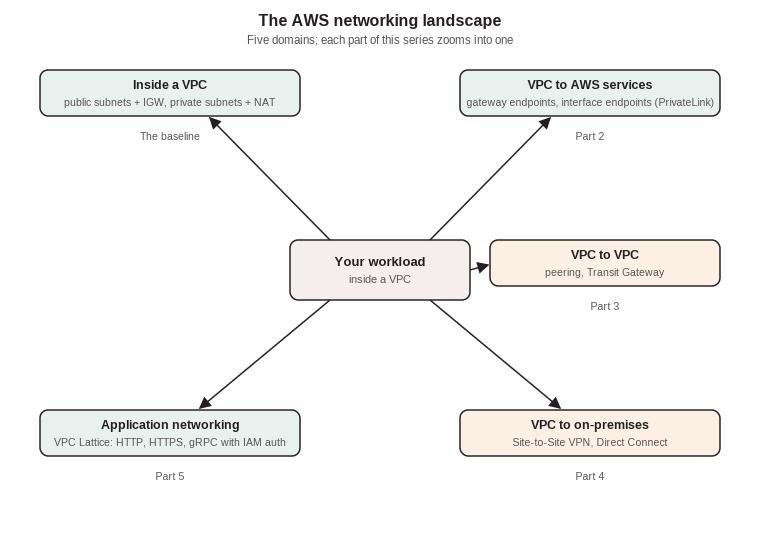 Tap the diagram to open it full size.
Inside a VPC
A VPC is your isolated network boundary, split into subnets across Availability Zones. Everything later in this series builds on this baseline.
Public subnets and Internet Gateways give workloads direct, two-way internet reachability. The deciding constraint is exposure: anything here sits on a publicly routable path, so I limit this tier to ingress components like load balancers.
Private subnets and NAT gateways allow outbound-only internet access while blocking unsolicited inbound internet traffic. “Private” only closes the public-internet door; permitted private traffic still arrives over peering, Transit Gateway, PrivateLink or hybrid links.
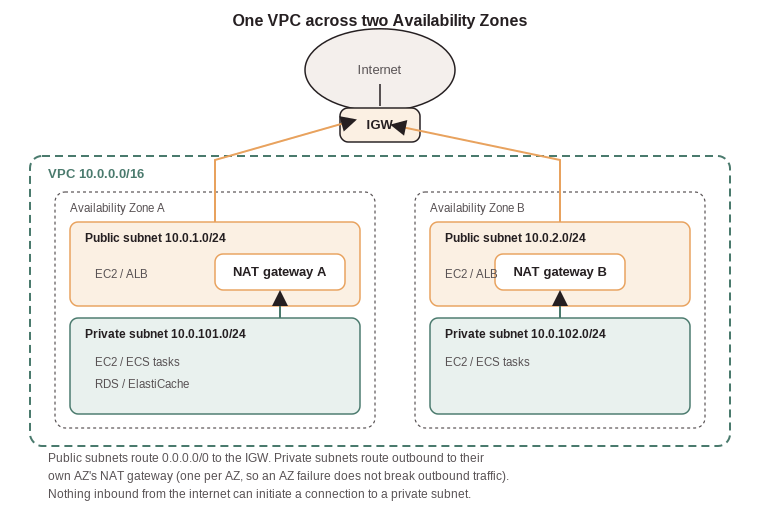 Tap the diagram to open it full size.
VPC to AWS services
Traffic to AWS services never needs the public internet. Two endpoint models cover this ground.
Gateway endpoints provide free, private access from a VPC to S3 and DynamoDB. The deciding constraint is reachability: they only work from inside that VPC, never over peering, Transit Gateway or hybrid links. Part 2 contrasts their scope with interface endpoints.
Interface endpoints (AWS PrivateLink) bring most other AWS, third-party and cross-account services privately into your VPC. The deciding constraint is cost and directionality: you pay per endpoint and per gigabyte, and connections flow strictly consumer-to-provider. Part 2 covers PrivateLink in depth.
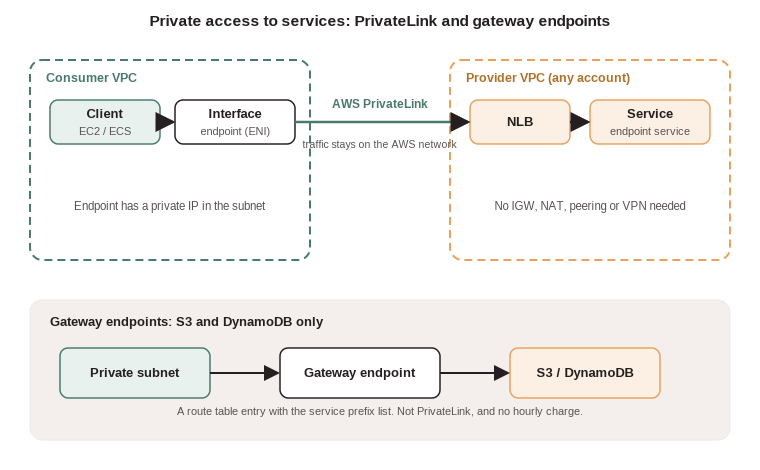 Tap the diagram to open it full size.
VPC to VPC
Once workloads span multiple VPCs or accounts, you choose between direct links and a hub.
VPC peering connects two VPCs directly over private IPs, across accounts and Regions. The deciding constraint is transitivity: peering is non-transitive, so a few VPCs stay simple while a full mesh at dozens becomes unmanageable. Part 3 examines when peering still wins.
AWS Transit Gateway (TGW) is a regional hub for VPCs and on-premises networks with centralised, transitive routing. The deciding constraint is scale versus cost: attachment and data-processing charges only pay off once peering sprawl hurts. Part 3 compares TGW and peering in depth.
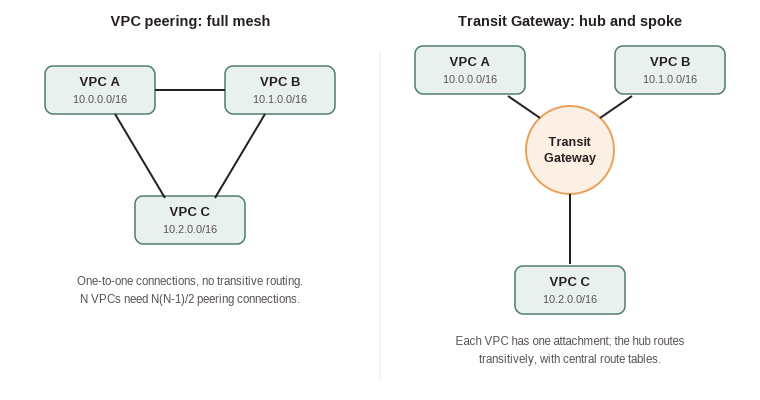 Tap the diagram to open it full size.
VPC to on-premises
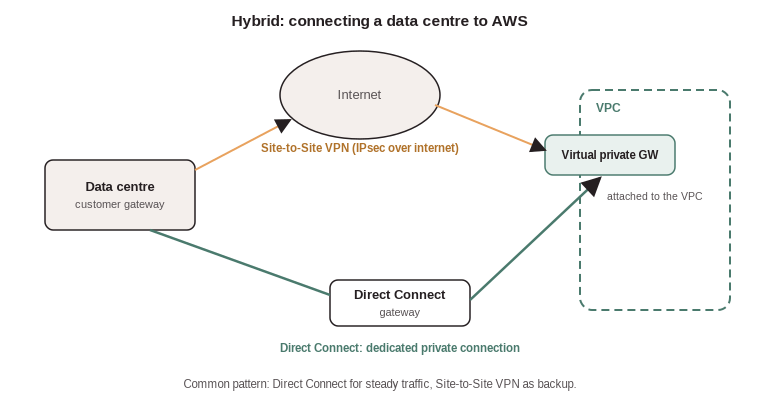
Connecting a corporate data centre to AWS comes down to two workhorses, often paired together.
Site-to-Site VPN builds encrypted tunnels over the public internet into AWS. The deciding constraint is predictability: fast and cheap to stand up, but latency and throughput ride on public internet routing. Part 4 covers hybrid design and failover.
AWS Direct Connect provides a dedicated physical link into the AWS backbone. The deciding constraint is lead time, cost and encryption: provisioning takes weeks, and private connectivity is not encrypted by default. Most teams pair it with a VPN backup, more in Part 4.
 Tap the diagram to open it full size.
Application and service networking
Everything above works at the network layer, CIDRs, routes and IPs.
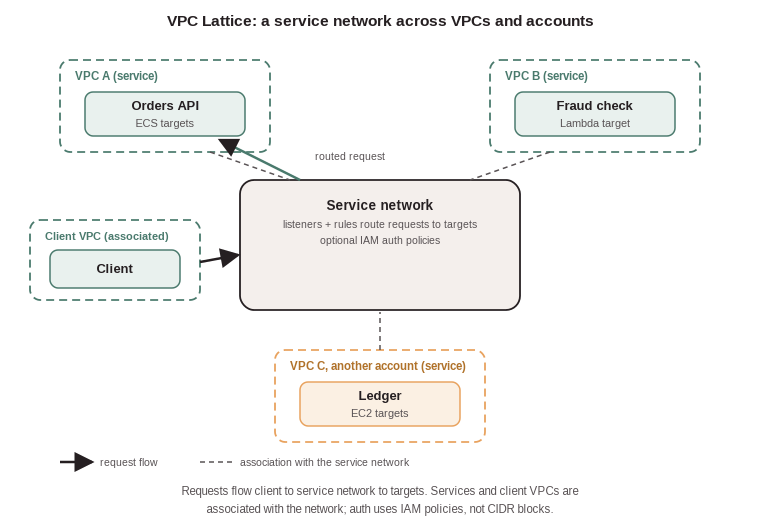
VPC Lattice works one layer up: managed application networking for HTTP, HTTPS and gRPC services across VPCs and accounts, sitting on top of your existing VPCs. The deciding constraint is scope: use Lattice when you want identity-based authorisation, traffic control and observability across many services rather than wiring routes between every pair. PrivateLink exposes one service to many consumers; Lattice connects many services to each other. Part 5 covers Lattice in depth.
 Tap the diagram to open it full size.
Choosing between them
No single option wins everywhere. Real architectures combine them: private subnets behind NAT, S3 over a gateway endpoint, a Transit Gateway between business units, a hybrid link to the data centre, and PrivateLink or Lattice across service boundaries.
The series
This post is the map; the rest of the series zooms into each territory:
- Part 2: PrivateLink and interface endpoints (next) - how to define an interface endpoint on the consumer side, and how to define an interface endpoint service behind a Network Load Balancer on the provider side.
- Part 3 (tentative): Transit Gateway vs VPC peering - routing topologies, multi-Region hubs and the real crossover point.
- Part 4 (tentative): Hybrid connectivity - Site-to-Site VPN, Direct Connect, encryption and resilient failover.
- Part 5 (tentative): VPC Lattice - service networks, identity-based auth and composing Lattice with PrivateLink.